Currently Empty: $0.00
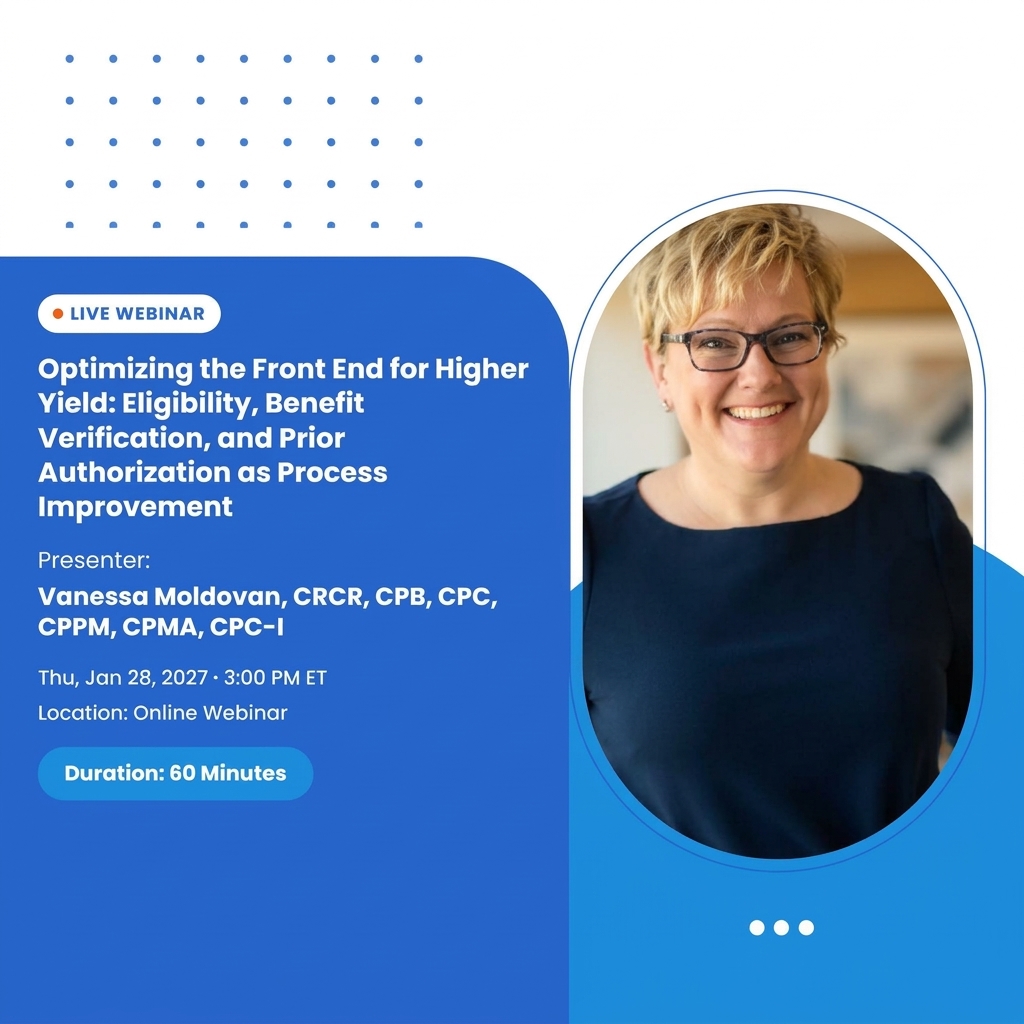
Optimizing the Front End for Higher Yield: Eligibility, Benefit Verification, and Prior Authorization as Process Improvement
Price range: $179.00 through $1,199.00
Most denials are decided long before a claim is submitted. They take shape at the front end of the revenue cycle, when coverage is assumed instead of confirmed, when a benefit detail is missed, or when an authorization is requested late or allowed to expire before the patient is seen. Correcting the problem weeks later costs far more than preventing it would have, and when prior authorization fails, a patient may be unable to receive treatment at all.
In this 60 minute session, revenue cycle veteran Vanessa Moldovan treats eligibility and benefit verification as one connected workflow and prior authorization as a second, and shows where each most often breaks down. She explains what to verify, when to verify it, and who should own each step. She also covers how to track authorization approvals and expiration dates, how to redesign a handoff so that complete information reaches billing the first time, and how to measure whether a change improved yield or simply moved the work downstream.
You will leave with a short list of fixes to test, beginning with your highest leakage point, and a practical plan for fewer denials, faster payment, and care that is not delayed.
Learning Outcomes:
- Identify the front end steps that most often cause denials, rework, and delayed payment in your own workflow.
- Apply a practical check for eligibility and benefit verification and prior authorization before the service, not after the denial.
- Explain eligibility and benefit verification as one workflow, including what to verify together, when to verify it, and who owns each step.
- Distinguish the benefit verification details that most often lead to a denied or underpaid claim, including coverage and patient responsibility.
- Track prior authorization requirements, approvals, and expiration dates so an authorization does not lapse before the service, and a patient is not left unable to receive treatment.
- Redesign one front end handoff so the right information reaches billing the first time, with clear ownership at each step.
- Use a small set of measures to tell whether a front end change improved yield, reduced denials, or only moved work later.
- Build a short list of fixes to test first, starting with the highest leakage point, and plan how to sustain the change.
Areas Covered in the Session:
- Eligibility Verification as a Process
- Not a single check
- What to verify
- When to verify it
- Who owns the check
- What happens when eligibility is missed or verified too late
- Benefit Verification in Practice
- Coverage
- Patient responsibility
- Deductibles
- Copays and coverage limits
- The details that most often lead to a denied or underpaid claim when they are incomplete, out of date, or checked after the service
- Prior Authorization from Request to Approval
- When it is required
- Who submits it
- How to track it in the system
- How to keep it from expiring before the service
- How to handle a denial
- A partial approval or a change in the plan
- How the Two Workflows Connect
- Where eligibility and benefit verification hands off to prior authorization
- How a delay or a gap in one workflow puts the other workflow and the patient at risk
- The Handoff from Front End to Billing
- The most common front end causes of denials
- How to spot them early and how to make the handoff clear, complete and owned
- Common Front End Denial Patterns
- Eligibility
- Benefit and authorization denials
- How to trace each pattern back to the step where it started
- Group denials by cause and use that grouping to choose the fix that will prevent the most denials
- Process Improvement Tools for the Front End
- How to map the current flow in plain steps
- Find the highest leakage points
- Test one fix with a small group first, and decide from the results whether to keep it, change it or try another approach
- Measuring the Front End
- Which simple measures show whether a change improved yield
- Reduced denials or only moved the work to another team
- Working with Patients at the Front End
- Clear communication about coverage
- Responsibility and authorization, so patients are not surprised later by a bill, a delay, or a treatment they cannot receive because authorization was not in place
- Sustaining the Fix
- Training for new and current staff
- Clear written procedures
- Regular review of denials and measures
- Feedback from the team doing the work
- A simple way to keep the new workflow in place after the first improvement
Recommended participants:
- Revenue Cycle Professionals
- Medical Billing Professionals
- Healthcare Administration Professionals
- Patient Access Professionals
- Patient Registration Staff
- Front-End Revenue Cycle Staff
- Insurance Verification Specialists
- Eligibility Verification Specialists
- Benefits Verification Specialists
- Prior Authorization Specialists
- Authorization Coordinators
- Pre-Registration Staff
- Medical Practice Administrators
- Practice Management Professionals
- Denial Management Professionals
- Claims Processing Specialists
- Patient Financial Services Staff
- Healthcare Operations Professionals
- Billing and Collections Staff
- Revenue Cycle Improvement Professionals
Presenter Biography:

Vanessa Moldovan, CRCR, CPB, CPC, CPPM, CPMA, CPC-I, is a healthcare revenue cycle executive with more than 20 years across billing and AR follow up, coding and auditing, revenue integrity, operations, consulting, and health technology strategy. She is currently an Assistant VP of Partnership Success with Ensemble Health Partners. She is the author of The Healthcare Revenue Cycle AI Playbook, founder of For the Love of Revenue Cycle, and an AAPC instructor and former AAPC National Advisory Board member.
She speaks and teaches on revenue cycle process improvement, AI and automation, denials, and change and transition, with a focus on practical work that helps providers get paid correctly and helps patients understand what they owe. Her teaching style is direct and practical, with examples from real workflows, clear steps to try, and simple measures that show whether the work is getting better.
Additional Information:
System Requirement:
- Internet Speed: Preferably above 1 MBPS
- Headset: Any decent headset and microphone which can be used to hear clearly
For more information, you can reach out to the below contact:
Toll-Free No: +1 800-757-9502
Email: cs@waymoreeducation.com